






Nike (NKE) gave investors a mixed quarter, but the market focused on the part that looked hardest to fix. Fiscal third-quarter revenue was $11.3 billion, essentially flat from a year earlier, while diluted earnings per share fell to $0.35 and gross margin slipped 130 basis points to 40.2%. The company also said inventories were still elevated at $7.5 billion.
The sharper problem was the outlook. Nike said fourth-quarter sales are expected to fall 2% to 4%, a weaker setup than many investors wanted to see from a turnaround story that is already well underway. Reporting after the release highlighted that the soft guide, more than the quarter itself, is what knocked the stock lower.
Nike wholesale is holding up better than direct
The split inside the quarter may be the most important part of the story. Nike’s wholesale revenue rose 5% to $6.5 billion, but Nike Direct revenue fell 4% to $4.5 billion. Inside that direct business, Nike Brand Digital fell 9% and Nike-owned stores fell 5%.
Shoppers appear more willing to buy Nike through wholesale partners than through Nike’s own digital and direct channels right now, which suggests the company is still rebuilding demand in the places where it once had the most control.
Running is working for Nike but China is not
Nike did have bright spots. Management said the company is seeing momentum in the areas it prioritized first, and market coverage pointed to running as one of the better-performing categories, with growth above 20% in the quarter. That shows demand is not weak everywhere.
China remains the bigger problem. Nike said Greater China revenue fell 10% in the quarter, and Reuters reported that management expects sales there to fall about 20% in the current quarter as the company works through older inventory and deals with a tougher local market. That leaves one of Nike’s most important growth regions acting more like a drag on the turnaround than a source of help.
Nike’s numbers
- Fiscal Q3 2026 revenue: $11.3 billion
- Wholesale revenue: $6.5 billion, up 5%
- Nike Direct revenue: $4.5 billion, down 4%
- Nike Brand Digital revenue: down 9%
- Gross margin: 40.2%, down 130 basis points
- Diluted EPS: $0.35
- Greater China revenue: down 10%
- Fiscal Q4 sales outlook: down 2% to 4%
What the chart says now
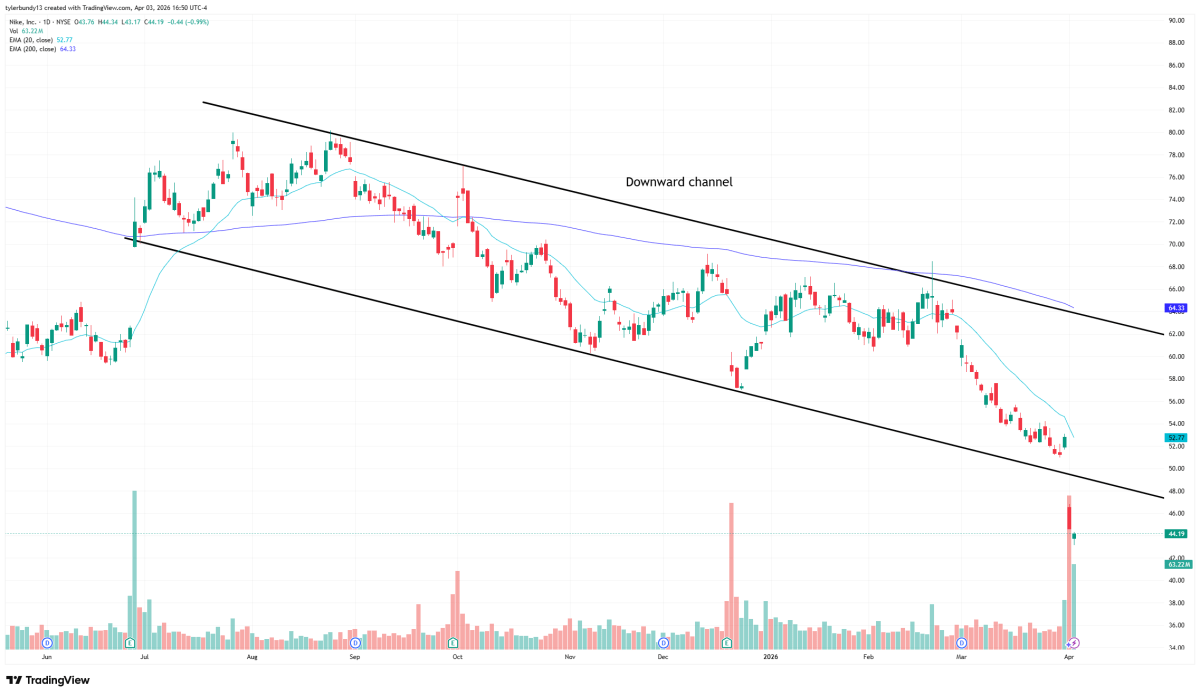
Nike’s chart has been weak for months, and the clearest feature is the downward channel that has guided the stock lower since last summer. That pattern matters because it shows the selling pressure has not been random. Price has repeatedly failed near the upper end of the channel and then rotated lower, which is exactly what a persistent downtrend tends to look like.
Trading View
The latest move makes the setup more serious. Nike has now broken below the lower end of that channel instead of simply bouncing inside it again. In the most recent session, the stock opened at $43.76, traded as high as $44.34, fell to $43.17, and closed at $44.19. The 20-day EMA sits at $52.77 and the 200-day EMA at $64.33, leaving Nike well below both trend markers. That is a bearish alignment and shows the stock is trading with weak short-term momentum inside a much weaker long-term trend.
What the break below the channel could mean
A breakdown below a long-running channel often tells investors the trend is not just continuing but accelerating. Instead of finding support at the lower boundary, Nike pushed through it, which suggests the market is pricing in more downside risk than the channel alone had implied. In practical terms, that can mean prior support zones are no longer doing their job, and sellers are becoming more aggressive on weak news.
The caution here is that breakdowns can sometimes turn into oversold bounces, especially after a sharp earnings-driven move. But for the chart to improve in any meaningful way, Nike would likely need to reclaim the lower edge of that channel and then build back toward the 20-day EMA near $52.77. Until that happens, the technical picture still favors rallies being treated as relief moves rather than the start of a real reversal.
Related: Space stock flies following successful Artemis II launch