





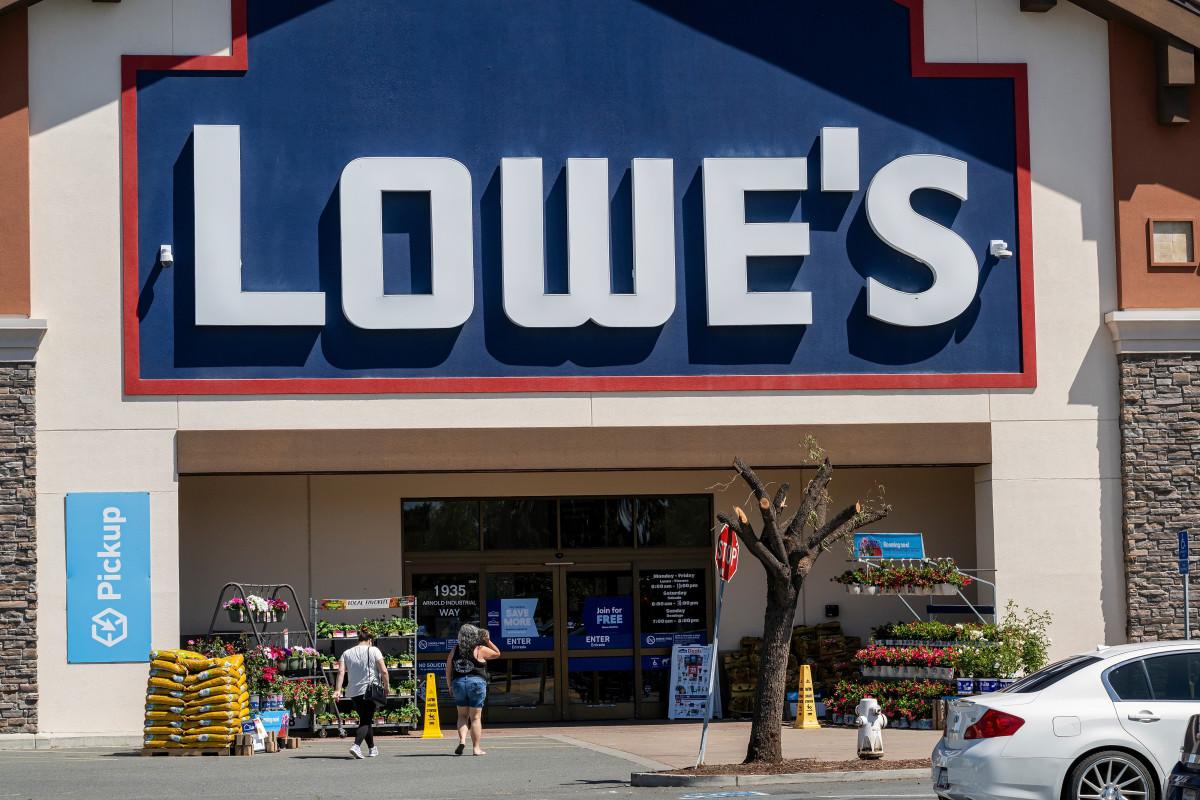

Have you noticed there are fewer staff at some of the large home retail chains? If you haven’t, you, like many, must be shopping there less often.
The truth is, the past year was a challenging one for the majority of home-improvement retailers, due to weak consumer demand caused by price increases, job losses, and higher interest rates.
The two biggest rivals in the space, Home Depot and Lowe’s, both experienced foot traffic declines, especially in the first half of 2025. In Q1, year-over-year foot traffic declined 3.8% for Home Depot and 3.5% for Lowe’s, due to “sluggish housing market and other economic headwinds,” according to data from Placer.ai.
It’s not that people are no longer interested in improving their homes. It’s just that the harsh economic situation has made them shift priorities to essential needs, such as food.
“Home sales stagnated as prices and mortgage rates have soared since 2022, due to the Federal Reserve raising rates to combat runaway inflation,” explained longtime Wall Street analyst and TheStreet Co-Editor-in-Chief Todd Campbell.
During an earnings call in November, Lowe’s CEO Marvin Ellison said affordability concerns and high interest rates in the housing market have largely impacted consumer spending.
“Affordability and uncertainty in the broader economy continue to weigh on consumer confidence, particularly when it comes to larger discretionary purchases, as borrowing costs have been elevated for longer than originally anticipated,” he said.
In response to shifting consumer behavior, Lowe’s keeps upgrading its services.
Lowe’s rolls out AI voice agents for all customer calls to store
There’s definitely something pleasant about walking through home-improvement aisles; it’s as if I immediately feel purposeful just by seeing the supplies.
However, when it comes to machines, tools, and materials, my knowledge is minimal. I often go shopping for my husband, who is a craftsman, but I do need help in the store.
And if there’s one thing that bothers me as a customer, it’s walking into a retailer and not finding anyone who can assist me. Lowe’s aims to solve this problem with new technology.
In 2025, Lowe’s began testing AI-powered voice agents, which use intelligent virtual agent (IVA) technology, across its stores. The project helped workers gain more time for face-to-face interaction with customers.
Chandu Nair, Lowe’s SVP for stores, data, artificial intelligence, and innovation, spoke with Retail Brew during CES about the company’s use of this AI tool.
Nair explained that before implementing a technology, Lowe’s ensures that it applies to a real, relevant problem. The retailer is not simply following the AI hype, he said.
Lowe’s removes distraction of ringing phones for workers on sales floor
“We get calls to our call centers, but we also get a lot of calls to our stores,” Nair explained. “It could be something [like], ‘Hey, what kind of concrete mix do you need? Do you know what time the store opens? What are the store hours?’ And it’s always hard for an associate who’s helping a customer on the floor to go and take a call.”
The test resulted in good containment rate responses, Nair said, meaning enough calls were answered without having to hand them off to a human. But the real question is how to further improve those containment rates and how to make sure the AI agent’s response is accurate.
Nair’s advice is to start small.
“There are a lot of great partners out there who can help augment and make sure that you start small, iterate, and make sure that you bring your core business functions along. This is 70% a change management game, 30% a technology game.”
Nair is aware of the limitation of the technology, explaining that making agentic AI consistently do what it should, at scale, is hard.
Beyond phone calls, Lowe’s is also exploring “physical AI” and robotics to improve its supply chain.
Home Depot also invests heavily in AI
I recently covered Home Depot’s launch of the Material List Builder AI, a tool specifically designed to help professional contractors and renovators turn project ideas into shopping lists in minutes rather than hours.
The new feature uses AI technology to interpret the project intent and generate a grouped list of materials needed for the entire job.
More Retail:
- Discount retail chain suddenly closes multiple locations
- Retail chain shuts all locations as legal changes hit industry
- Lululemon struggles to reverse concerning customer behavior
Instead of searching for individual parts, users can simply describe the project in plain English. For example: “We’re doing a primary bathroom remodel, replacing the double vanity with a more modern one, adding new recessed lighting, two new mirrors, and a new toilet.”
After such an input, the AI will automatically generate a grouped list of every necessary item, from the vanity to the recessed lighting. It allows pros to build these lists using natural language, voice-to-text for hands-free work on a job site, or by simply pasting text from emails and spreadsheets.
“Material List Builder AI generates reliable, comprehensive job lists in a fraction of the time it would take to complete this process manually, and Pros can then spend more time focused on their customers and the job at hand,” said Mike Rowe, executive vice president of Pro for The Home Depot.
Home Depot, Lowe’s AI strategies differ
Both giants are investing in AI to improve its operations; however their strategies are different. Home Depot is taking a more disciplined, execution-first approach. Instead of a total overhaul, the company is implementing AI in specific areas where it is already powerful, writes Zacks Investment Research.
On the other hand, Lowe’s is treating AI as foundational infrastructure, meaning it’s rebuilding its entire business mode around it. The goal is to help nervous DIYers feel like experts and help every employee increase their consultant skills with tools like MyLowe Companion.
“Internally, Lowe’s is using AI to amplify human expertise rather than replace it,” points out Zacks.
If many prefer human help, will Lowe’s customers like AI support?
Lowe’s latest move to improve human customer interactions at the store aligns with recent industry data that confirms this is an important part of the consumer experience.
According to Deloitte’s 2026 Retail Industry Outlook, as much as 40% of consumer perceptions of a brand’s value comes from factors other than price. “Depending on the subsector, factors such as quality, customer service, ease of checkout, loyalty programs, and even employee attitudes can sway consumers.”
While Lowe’s new AI strategy aims to improve in-store customer experience, the question is whether consumers who are calling and speaking with AI agents feel satisfied.
Even though Lowe’s SVP Nair said that containment rates are good, industry data shows that 84.7% of consumers prefer interaction with a human over an AI agent.
Moreover, even when assured that AI could resolve their issue, more than 80% still wanted a person, according to Metrigy’s Customer Experience Optimization 2025-26 consumer views study.
Related: Dollar General makes key move Target, Walmart can’t beat